







AI has made content creation faster than ever. A business can now create a blog outline, product description, service page, FAQ section, or social media caption within minutes. This speed is useful, but it also creates a serious problem: many businesses are publishing content faster than they are thinking.
This is where AI-generated SEO content starts failing.
The problem is not that AI was used. The problem is that AI is often used without proper research, without search intent, without human editing, and without real subject knowledge. Many businesses give a basic prompt, copy the output, publish it, and expect rankings to improve.
That is not SEO.
A real-life example makes this easier to understand. In SEO, creating backlinks is important, but simply building thousands of random backlinks does not mean your website will rank. A good backlink strategy depends on relevance, authority, niche connection, anchor text, quality, and natural placement. Random backlinks can even damage a website.
AI content works in the same way.
Just because AI can generate 100 blogs does not mean those blogs will help your website grow. If the content is generic, repetitive, poorly researched, and not useful for the reader, it will not perform well. AI is only a tool. The result depends on how humans use it.
Google has also clarified that it focuses on the quality and usefulness of content rather than only how the content is produced. AI-generated content is not automatically against Google Search guidelines, but content created mainly to manipulate rankings or produced at scale without adding value can create problems.
Why do businesses fail with AI-generated SEO content?
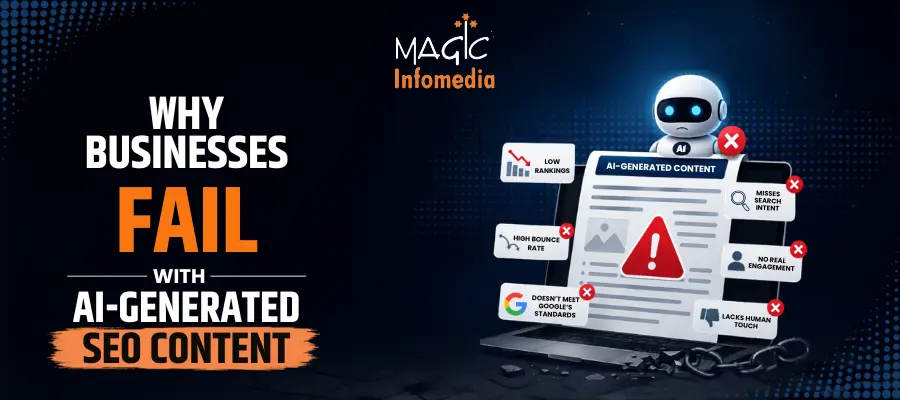
Businesses fail with AI-generated SEO content because they use AI as a shortcut instead of using it as a support tool. Poor research, weak prompts, lack of search intent, no human editing, missing E-E-A-T, and generic information make AI content low-value. AI content can perform well when guided by expert SEO strategy, proper keyword research, user-focused writing, analytics data, and human review.
What Google Says About AI-Generated Content
Google does not say that AI content is automatically bad for SEO. Google’s official guidance explains that using AI or automation is not against its guidelines when the content is helpful, original, and created for people. The main concern is content created mainly to manipulate search rankings or produced in bulk without adding real value for users.
Google also states that generative AI can be useful for researching a topic and adding structure to original content. However, using AI tools to generate many pages without adding value may violate Google’s spam policy on scaled content abuse.
So, the right understanding is simple: Google is not against AI content. Google is against low-quality, unhelpful, and manipulative content.
The Real Problem: Businesses Misuse AI
Many businesses use AI with the wrong mindset. They think AI can replace SEO strategy, content planning, expert writing, and user understanding. This is where the failure begins.
A common process looks like this:
- Open an AI tool
- Enter a basic prompt like “Write a blog on SEO”
- Copy the output
- Add a few keywords
- Publish it directly
- Expect rankings
This approach usually creates average content. It may look clean, but it does not offer anything new. It does not show experience. It does not solve the user’s real problem. It does not build trust.
An SEO expert does much more than just write content. A professional SEO expert first understands the business, target audience, customer journey, search behaviour, and website performance. They check Google Analytics, Google Search Console, keyword data, landing page performance, user behaviour, bounce rate, engagement, and conversion patterns before deciding what type of content should be created.
AI cannot do this by itself unless it is given the right information, command, and prompt.
For example, AI will not automatically know which service page is losing traffic, which keyword has high impressions but low clicks, which blog needs improvement, or what type of content users are expecting. An SEO expert identifies these gaps and then guides AI to create content with the right direction. So, the issue is not AI. The issue is using AI without SEO intelligence.
Good SEO content needs more than words. It needs business understanding, user behaviour analysis, search intent, keyword strategy, real examples, content structure, and continuous improvement.
Example: AI Content Is Like Backlink Building
Backlink building is a good example to understand AI content.
A business may think: “More backlinks mean better SEO.”
But an SEO expert knows this is not always true. A backlink from a relevant industry website is more
valuable than hundreds of random links from unrelated websites
For example, if a digital marketing agency gets a backlink from a reputed marketing publication, SEO resource website, SaaS partner page, business magazine, or industry-specific blog, it can help authority. But if the same agency gets hundreds of backlinks from spam directories, unrelated websites, or low-quality domains, those links can damage trust instead of improving rankings.
The same logic applies to AI content.
A business may think: “More blogs mean better SEO.”
But an SEO expert knows that more content only helps when each page has a unique purpose, clear search intent, strong topical relevance and useful information.
Publishing 100 generic AI-written blogs is not a content strategy. It is content noise.
Why AI-Generated SEO Content Fails
1. Poor Research Creates Poor Results
AI output depends heavily on the information and direction given by the user. If the research is weak, the final content will also be weak.
For example, if a digital marketing agency wants to write a blog on SEO services for small businesses, the content should not only explain what SEO is. It should also cover real user concerns such as:
- How SEO helps small businesses get leads
- Why local SEO matters
- How Google Business Profile improves visibility
- Why keyword research should match buyer intent
- How content and backlinks work together
- How long SEO results usually take
- What mistakes small businesses should avoid
- How SEO performance is measured through traffic, leads, rankings, and conversions
A basic AI prompt may only create a general article saying that SEO improves rankings and brings website traffic. That information is correct, but it is too common and does not add enough value.
Users are not just looking for definitions. They want practical answers. They want to understand whether SEO can actually help their business grow. Search engines also prefer content that properly satisfies the user’s query.
How to Fix It
- Target keyword
- Search intent
- Audience type
- Competitor gaps
- Google Analytics insights
- Google Search Console data
- Real user questions
- Business goals
- Service details
- Expert insights
- Internal linking opportunities
- FAQs
- Trust signals
AI becomes more useful when the SEO expert gives it the right research, direction, and prompt.
2. Weak Prompts Lead to Generic Content
AI does not automatically know your goal. It follows the prompt. A weak prompt gives weak content.
Weak Prompt Example
“Write a blog on your <<Your Research Content Topic>> using the target keywords <<Keyword 1>>,
<<Keyword 2>>, <<Keyword 3>>, <<Keyword 4>>, and so on. Also include a basic outline with important sections such as headings, CTA, FAQs, meta title, meta description, and other SEO elements.”
This may create a basic article with common points. It may include keywords, but it will not have a strong angle, examples, or depth.
Key Point: AI output is only as strong as the human input behind it.
3. Businesses Ignore Search Intent
Search intent means understanding what the user actually wants when they search.
For example, a user searching “Is AI content bad for SEO?” may want to know:
- Does Google penalize AI content?
- Can AI content rank?
- What are the risks of AI content?
- How should AI be used safely?
- What does Google say about AI content?
- How can businesses improve AI-written content?
If the blog only says “AI content is bad” or only promotes a service, it does not satisfy the user.
| Search Intent | User Need | Content Requirement |
| Informational | Wants to learn | Explain concepts clearly |
| Commercial | Comparing solutions | Show benefits, process, trust |
| Transactional | Ready to take action | Add CTA, service details |
| Navigational | Looking for a brand/page | Make brand access easy |
AI can help write content, but an SEO expert decides which intent the content should target.
4. Content Lacks E-E-A-T
E-E-A-T stands for Experience, Expertise, Authoritativeness, and Trustworthiness. AI-generated content often lacks E-E-A-T because it does not naturally include real project experience, expert opinion, author credibility, case examples, verified sources, practical advice or brand-specific knowledge.
This is why human involvement matters.
How to Add E-E-A-T to AI Content
- Author bio and credentials
- Expert review
- Real examples
- Case studies
- Screenshots or data
- Trusted external references
- Internal links to related resources
- Clear explanation based on experience
For example, instead of saying “Good content improves SEO,” write: “In SEO projects, content usually performs better when it answers the exact stage of the user journey. A comparison page should not be written like a basic educational blog because the user is already evaluating options.”
The second version shows applied knowledge.
5. AI Content Often Sounds Repetitive
Many AI-written blogs follow the same pattern: generic introduction, similar subheadings, repeated points, broad conclusion, no unique opinion, and no real examples. This creates content that looks complete but does not feel useful.
Users can feel when content is written only to fill space. Search engines are also becoming better at identifying low-value and repetitive content patterns.
How to Fix It
- Improve tone and flow
- Add practical examples
- Verify accuracy
- Remove repetition
- Improve readability
- Add brand voice
- Include original insights
- Explain the topic practically
AI can create the base. Humans must create the value.
6. Businesses Publish Too Much Content Without Strategy
AI makes it easy to create content at scale. But scale without strategy can harm SEO. For example, a website may publish multiple similar blogs such as “What is digital marketing?”, “Benefits of digital marketing,” “Why digital marketing is important,” and “Digital marketing guide.”
If these pages overlap too much, they may compete with each other. This is called keyword cannibalization. Instead of improving rankings, the website becomes confusing for search engines.
How to Fix It
- Create one main pillar page
- Build supporting blog topics
- Use clear internal linking
- Give every page a unique keyword target
- Avoid duplicate search intent
- Build topic clusters by category
This builds topical authority.
Pros and Cons of AI-Generated SEO Content
Pros of AI Content for SEO
- Faster Content Production: AI helps create outlines, drafts, FAQs, and summaries quickly.
- Better Idea Generation: AI can suggest blog topics, subheadings, keyword variations, and content angles.
- Useful for Content Structuring: AI can organize content into headings, bullet points, FAQs, and sections.
- Helps Improve Readability: AI can simplify complex content and make it easier for users to understand.
- Good for First Drafts: AI can create a starting point for writers and SEO teams.
Cons of AI Content for SEO
- Can Sound Generic: Without expert input, AI content may repeat common information already available online.
- May Include Incorrect Information: AI can produce confident but inaccurate statements, so fact-checking is important.
- Weak E-E-A-T: AI does not automatically add experience, authority, or trust signals.
- Poor Search Intent Matching: AI may target a keyword but miss the real reason behind the search.
- Risk of Scaled Low-Value Content: Publishing large amounts of AI content without adding user value can create SEO risk.
How to Use AI for Better SEO Content
Step 1: Start With the User Problem
Before writing, ask what problem the user is trying to solve, what question they are asking, what decision they are trying to make, and what information will help them move forward. SEO content should begin with the user, not the keyword.
Step 2: Do Keyword and Intent Research
Identify the primary keyword, secondary keywords, LSI keywords, search intent, ranking competitors, content gaps, and FAQ opportunities. AI can help organize this research, but the SEO expert should validate it.
Step 3: Give AI a Strong Brief
A strong brief should include topic, audience, search intent, main keyword, secondary keywords, tone, heading structure, examples, FAQs, CTA, word count, and brand positioning. The better the brief, the better the AI output.
Step 4: Use AI for Drafting, Not Final Publishing
Treat AI content as a first draft. Before publishing, check accuracy, originality, user value, search intent alignment, natural keyword usage, readability, E-E-A-T, and human tone.
Step 5: Add Expert Insight
This is where the content becomes valuable. Add real examples, personal experience, industry-specific points, data, case references, practical recommendations, and clear opinions. AI can write sentences. Experts create meaning.
Step 6: Optimize for User Behaviour
SEO is not only about ranking. It is also about how users behave after landing on the page. Improve page structure, readability, internal links, CTA placement, FAQs, visual hierarchy, content flow, and mobile experience.
AI Content and User Behaviour: A Practical Example
Imagine two digital marketing agencies publish a blog on the same topic: “Best SEO Strategies for Small Businesses.”
Website A Uses AI Poorly
The content says SEO improves visibility, keywords are important, backlinks help ranking, content should be high quality and businesses should use social media. This is correct, but too basic. The user learns nothing new.
Website B Uses AI With Expert SEO Guidance
The content explains how local businesses should choose keywords, why service pages need city-specific intent, how Google Business Profile supports local SEO, why niche backlinks matter more than random backlinks, how to improve content based on user behaviour, which pages should be created first, and how to measure ranking and conversion improvement.
Website B gives practical value. It answers real questions. It builds trust. Both websites used AI, but only one used AI properly.
AI Can Assist Content Creation, But Human Expertise Drives SEO Results
A calculator can solve numbers quickly, but it cannot decide a company’s financial strategy. A camera can take a photo, but it cannot automatically create a brand campaign. A design tool can create layouts, but it cannot understand customer emotion by itself.
In the same way, AI can generate content, but it cannot fully replace SEO strategy, human judgment, industry experience, search intent understanding, brand voice, trust building, and conversion planning.
AI can write content, but it cannot understand your business performance, user behaviour, search gaps, or conversion problems unless an expert studies the data and gives it the right direction.
The result depends on the expert using the tool.
SEO Checklist for AI-Assisted Content
- The content answers the user’s query clearly
- The keyword is used naturally
- The article has a clear heading hierarchy
- Search intent is properly matched
- The content includes real examples
- E-E-A-T signals are present
- Facts are verified
- Repetition is removed
- The tone matches the brand
- Internal links are added
- Meta title and description are optimized
- FAQs are included
- The content is written for users first
- The page has a clear next step or CTA
Conclusion
Businesses do not fail with AI-generated SEO content because AI is bad. They fail because they use AI without strategy.
AI is a tool. It can make content creation faster, easier, and more structured. But the quality of the result depends on the person using it. Poor research, weak prompts, lack of user understanding, no analytics review, and no human editing will always create poor results.
Just like backlink building is not about creating random links, AI content is not about generating random blogs. SEO success comes from relevance, quality, intent, trust, and continuous improvement based on user behaviour.
The right approach is not AI vs human.
The right approach is: Human strategy + AI support + SEO expertise + user-focused content.
When AI is used with proper research, strong prompts, E-E-A-T, expert editing, analytics insights, and search intent optimization, it can help businesses create content that is useful for users and valuable for search engines.
Frequently Asked Questions
No, AI-generated content is not automatically bad for SEO. It becomes a problem when it is generic, unedited, inaccurate, repetitive, or created only to manipulate rankings. Google focuses on helpful and reliable content, not only on whether AI was used
Yes, AI-assisted content can rank on Google if it is useful, original, accurate, and aligned with user intent. Human editing, E-E-A-T and expert SEO strategy improve its chances of ranking.
The biggest mistake is publishing raw AI output without research, fact-checking, search intent mapping, analytics review, or human editing.
AI can be used for topic research, outlines, first drafts, FAQs, meta descriptions, content refreshes, and readability improvements. However, final content should be reviewed and optimized by an SEO expert.
Google does not penalize content only because AI was used. However, content created at scale without value or mainly to manipulate search rankings can violate Google’s spam policies.
Human editing adds accuracy, experience, examples, brand tone, trust, and practical value. These elements help content become more useful for both users and search engines.
E-E-A-T helps show that the content is based on experience, expertise, authority, and trust. AI content needs human input to build these signals properly.