









Artificial intelligence (AI) has changed the way sellers build and grow product listings on Amazon, eBay, Walmart, and other marketplaces. It can quickly create descriptions, place keywords, and make the process faster and easier.
But automation isn’t foolproof. Sometimes it makes mistakes like adding wrong product details, stuffing too many keywords, breaking marketplace rules, or writing copy that sounds robotic. These errors can hurt visibility, lower sales, and even cause policy issues.
In this guide, we’ll show you how to identify and fix AI oversights in multi-channel product listings. You’ll discover common errors, simple step-by-step solutions, and practical strategies to keep your listings accurate, consistent, and more visible across platforms.
Why AI Oversights Happen in Product Listings
AI is only as good as the data it’s trained on. While it can speed up product listing automation, it often misses details when:
- Training data doesn’t match actual product specifics.
- AI generates generic or repetitive descriptions.
- Errors slip in during translation for cross-platform product listings.
- Each marketplace (like Amazon vs. Walmart) has different rules that AI can’t fully handle without human checks.
These AI errors in multi-channel listings can range from simple typos to severe misrepresentations that break compliance rules. For sellers selling on multiple marketplaces, oversight management becomes critical.
Common AI Listing Mistakes Across Marketplaces
Here are the most frequent AI mistakes sellers encounter on platforms like Amazon, eBay, and Walmart:
1. Keyword Overuse or Irrelevant Terms
AI sometimes stuffs trending keywords into titles or descriptions, even if they don’t fit. Instead of boosting ranking, this can hurt search performance.
2. Wrong Product Details
Automated tools may list the wrong size, features, or compatibility info. These errors make listings unreliable and damage buyer trust.
3. Branding and Tone Issues
AI-generated text often feels robotic or fails to match your brand’s voice. For sellers managing multi-channel listings, this inconsistency can weaken credibility.
4. Breaking Marketplace Rules
Each platform has its own rules—image sizes, word limits, restricted terms. AI tools often miss these nuances and create compliance risks.
5. Duplicate or Confusing Information
When publishing across different marketplaces, AI may create slightly different product details. This inconsistency confuses shoppers and reduces conversions.
How to Identify AI Oversights in Product Listings
Catching AI oversights requires both automation and human touch. Here’s how:
1. Check Customer Feedback
- Look at product reviews and Q&A sections to find errors AI might have missed.
- Example: If buyers keep asking about compatibility, your listing may not include the right details.
2. Run Multi-Platform Audits
- Use tools like Channel Advisor product management to check for consistency across Amazon, eBay, Walmart, and more.
- Review titles, prices, and bullet points across Amazon, eBay, and Walmart to make sure everything matches.
3. Do Human Reviews
- AI speeds up content creation, but it can’t replace human judgment. A quick manual check helps catch issues with tone, branding, and AI listing mistakes on Amazon/eBay/Walmart.
4. Compare with Competitors
- Compare your listings with top competitors on each marketplace. This helps identify where AI-generated content is underperforming in visibility.
Step-by-Step: Fixing AI Oversights in Online Marketplaces
Now let’s look at how to fix AI oversights in online marketplaces systematically:
Step 1: Audit Listings by Platform
- For Amazon, check Amazon product listing optimization guidelines (title length, bullet points, back-end keywords).
- For eBay, run eBay product listing help checks, focusing on structured data fields.
- For Walmart, use Walmart product listing solutions to align with their category-specific requirements.
Step 2: Standardize Content Across Platforms
- Implement a central hub for multi-channel product listing to reduce inconsistencies.
- Tools like Channel Advisor can synchronize product data across marketplaces.
Step 3: Improve Keyword Relevance
- Replace AI-stuffed or irrelevant keywords with researched terms to optimize product listings for e-commerce platforms.
- Consider both branded and non-branded search terms to improve product visibility across platforms.
Step 4: Correct Product Specifications
- Verify dimensions, features, and compliance requirements against manufacturer specs.
- Human review is key for e-commerce listing accuracy.
Step 5: Refine Tone and Branding
- AI tends to generate generic text. Rewrite to match your brand voice and ensure consistency across cross-platform product listings.
Step 6: Monitor and Update
- Schedule quarterly audits to track new AI errors in multi-channel listings and ensure ongoing compliance.
Multi-Channel E-Commerce Listing Strategies
To scale effectively, sellers must adopt multi-channel e-commerce listing strategies that balance automation with oversight. Here are best practices:
Centralized Product Data Management
Use a single platform like Channel Advisor product management to push consistent data across Amazon, eBay, Walmart, and Shopify.
Automation + Human QA
Leverage automated product listing solutions for efficiency, but always layer human checks to fix AI mistakes.
Platform-Specific Tailoring
Avoid a one-size-fits-all approach. Customize titles and descriptions for each marketplace (e.g., Amazon product listing optimization differs from eBay product listing help).
SEO Across Marketplaces
Optimize for marketplace search algorithms while also ensuring visibility on Google Shopping and other discovery platforms.
Data-Driven Improvements
Use analytics from Amazon Brand Analytics, eBay seller tools, and Walmart analytics to improve product visibility across platforms continuously.
.
The Role of Automated Product Listing Solutions
Automation isn’t the enemy—when paired with oversight, automated product listing solutions save time and scale your reach. Benefits include:
- Efficiency: Faster uploads for thousands of SKUs.
- Consistency: Reduced manual errors in multi-channel product listing.
- Scalability: Easier management when selling on multiple marketplaces.
However, without checks, automation can create AI listing mistakes on Amazon/eBay/Walmart that hurt performance. Sellers must maintain a balance between automation and human input.
Case Example – Selling Across Multiple Platforms
Let’s consider a mid-size electronics brand distributing products on Amazon, eBay, and Walmart. At first, they relied solely on AI to create and publish listings:
- Amazon: Titles became overly keyword-heavy, which hurt organic ranking and made products look spammy.
- eBay: Structured fields were left incomplete, limiting visibility in eBay’s search filters
- Walmart: Product descriptions lacked technical specs, leading to frequent customer questions and low trust.
By switching to a hybrid approach—automation for speed and human review for quality—the brand corrected these issues:
Optimized Amazon titles for search intent and readability.
- Completed eBay’s structured data fields to improve discover ability.
- Updated Walmart listings with verified specs and compliance checks.
The result?
- 15% higher visibility across channels within 90 days.
- –20% returns from clearer specifications.
- Stronger, consistent branding across marketplaces.
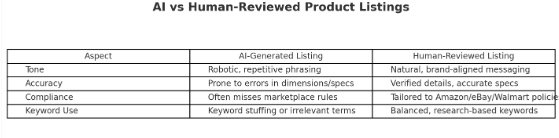
AI vs Human-Reviewed Product Listings
AI tools are fast and efficient, but they often miss critical nuances. Automated product listing solutions can generate thousands of SKUs quickly, yet they may overlook tone, branding consistency, or compliance rules.
By contrast, human-reviewed product listings ensure accuracy, brand alignment, and better readability. Human oversight catches issues like incorrect specifications, keyword stuffing, or mismatched product details that AI tends to overlook.
The winning approach is AI + human QA: let automation handle scale, while human review refines quality and trust worthiness.
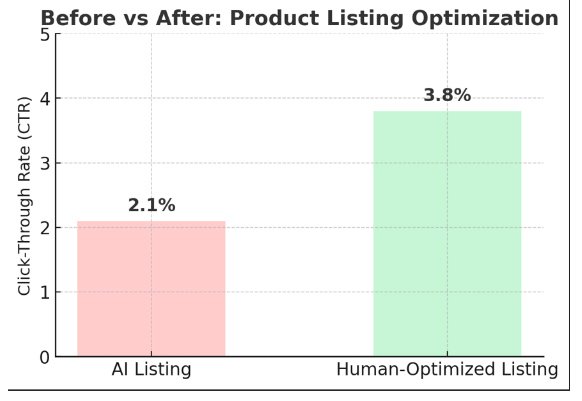
Before vs After: Product Listing Optimization
Here’s an example of how optimization transforms listings:
Before (AI-Generated Only):
- Title: “Best Wireless Bluetooth Headphones 2025 High Quality Music Sound”
- Description: “These headphones are Bluetooth. They are good. Many people use them for music.”
- Issues: Keyword stuffing, poor readability, missing specs, weak branding tone.
After (AI + Human Optimization):
- Title: “Wireless Bluetooth Headphones with Noise Cancellation | 40-Hour Battery Life”
- Description: “Experience crystal-clear audio with wireless Bluetooth headphones designed for music lovers. Featuring active noise cancellation, 40 hours of battery life, and universal device compatibility, these headphones deliver comfort and performance—perfect for travel, work, and everyday use.”
- Fixes: Relevant keywords, clear specifications, benefits-driven copy, stronger SEO alignment.
By pairing AI efficiency with human refinement, sellers improve e-commerce listing accuracy and significantly boost conversions.
Best Practices to Ensure E-Commerce Listing Accuracy
- Check AI outputs line by line for errors.
- Tailor copy per marketplace instead of copy-pasting.
- Monitor analytics to identify performance dips caused by listing oversights.
- Schedule audits using third-party tools and manual reviews.
- Document workflows for repeatability in your multi-channel e-commerce listing strategies.
Conclusion
AI can supercharge your multi-channel product listings, but unchecked oversights undermine performance and trust. By combining automated product listing solutions with human oversight, you can catch errors early, maintain compliance, and improve product visibility across Amazon, eBay, Walmart, and beyond.
The formula is simple: audit, correct, and optimize. Use centralized tools like ChannelAdvisor, apply platform-specific SEO best practices, and schedule regular reviews to prevent new AI errors.
Need help optimizing your multi-channel product listings?
Contact Magic Info Media today to optimize your multi-channel product listings, boost conversions, and turn AI from a risk into a competitive advantage.