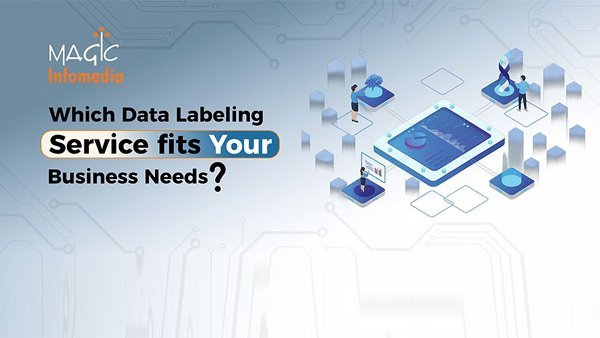

Choosing the right data labelling service can feel oddly similar to choosing the right fuel for an engine, you may not think about it at first, but the entire system fails without it. With AI models demanding cleaner, richer and faster-labelled data than ever, businesses now rely heavily on data labeling services and AI data annotation to stay competitive. The challenge is knowing which option truly fits, whether it’s a high-volume image labeling service, a precise text annotation service, or a fully scalable data labeling solution you can easily plug into.
This guide breaks down exactly how to assess your needs, what service types actually matter, and how top data annotation companies structure high-quality workflows. Expect simple explanations, actionable advice, fresh statistics, and insights drawn from real-world project patterns. If your goal is to build smarter models, avoid costly mistakes, and pick a professional data labeling solution that supports long-term AI growth, this is where the clarity begins.
Why Is Data-Labelling So Important?
- A deep-learning model is only as good as its training data — garbage in, garbage out.
- As models become more complex, they need higher accuracy, better context, and coverage for edge-cases and rare scenarios.
- Many companies don’t have the internal time or expertise to manage large, high-quality annotation work, so they rely on specialist data annotation companies.
- Scalability also matters. Doing a small amount of labelling is easy; running a large, ongoing annotation pipeline is a different challenge.
If your business is reaching the point where you need to outsource labelling or upgrade your current process, you’re in the right place.
Quick Self-Audit: What Does Your Business Need?
Before jumping to vendor screens, answer the following. The clarity you gain now will make everything easier.
- What type of data? Is it text, images, video, audio? For example, an autonomous vehicle project leans hard on image/video labelling; an NLP product leans text annotation.
- What volume and velocity? Do you need thousands of items or millions, on a tight schedule? If you must scale fast, you need a partner used to volume.
- What quality/precision level? Do you need simple classification (image has cat vs dog) or complex segmentation (bounding boxes, polygon masks, 3D labelling)?
- What domain expertise? Some industries (healthcare, automotive, finance) demand annotators who understand domain specifics.
- Will you manage in-house or outsource? Outsourcing means relying on a partner; in-house means building capability. Many select outsource data labelling to reduce risk and speed time-to-market.
- What compliance/security needs? If data is sensitive (patient records, proprietary video feeds), vendor security, certifications and process controls matter.
If, for example, you have a high-volume image project, need fast turnaround and don’t possess in-house annotation teams, then a professional data labelling service is the smart play. If you have smaller text-based tasks and budget constraints, a simpler text annotation service with fewer bells might suffice.
Types Of Services: A Snapshot
Here’s a breakdown of common offerings, how they differ, and how to know when each fits.
| Service type | Focus | When to pick it |
|---|---|---|
| Image / Video labelling service | Objects, scenes, segmentation, tracking. Often used in vision, autonomous vehicles, retail imagery. | When your model processes visual input, not just text. |
| Text annotation service | Sentiment tagging, entity extraction, conversation labelling, language understanding. | When your AI is NLP-centric (chatbots, document analysis). |
| Audio / speech annotation | Transcriptions, speaker diarisation, voice commands, accent identification. | Voice assistants, speech-to-text pipelines. |
| Hybrid / multi-modal annotation | Combines text + image + audio, or complex datasets (e.g., video with sensor metadata). | Cutting-edge projects combining modalities. |
| Scalable data labelling solutions | Emphasis on large volume, fast turnaround, robust pipelines, quality control frameworks. | When you are ramping up, you need enterprise-grade throughput. |
Every business doesn’t need all of them. The key is matching your needs. As one industry insider put it: “You wouldn’t hire a full vehicle labelling team if you only need text categorisation for a chatbot”.
How To Pick The Right Service Fit For Your Business
Putting it together: here are the actionable steps to decide which service fits your needs right now.
Clarify your goal: e.g., build a model to classify medical images; improve search relevance using NLP; automate support-ticket tagging.
- List your data types & volume: How many images, text samples, etc? What velocity?
- Set quality criteria: Acceptable error rates? Domain nuance? Rare classes?
- Decide sourcing model: In-house vs outsource? Based on budget, timeline, internal skills.
- Select service type: If image/video heavy → image labelling; text heavy → text annotation; multi-modal → hybrid.
- Short-list vendors: Evaluate using the criteria above (domain, scale, QA, security).
- Pilot project: Always run a small pilot (say 1 % of full scale) to test magnitude, flow, quality before full deployment.
- Scale and monitor: Once the pilot passes, ramp up. Monitor KPIs (error rate, turnaround, cost per label) continuously.
- Iterate your annotation schema: As model changes, your data requirements may change. Make sure service is flexible.
- Plan future-proofing: As your model evolves (new classes, edge-cases), the service should adapt.
By following these steps, you don’t just pick a service, you align your business-needs with the right annotation strategy, minimize wasted spend, and improve model ROI.
Cases Where Each Service Shines
- If your business builds a visual-recognition system (e.g., retail product detection, manufacturing defect identification) → go for a robust image labelling service with segmentation & bounding box expertise.
- If you’re building a conversational AI or document-analysis tool → you’ll prioritise a strong text annotation service (NER, sentiment, entity extraction).
- If you already have expert internal annotators but lack volume → select a partner offering scalable data labelling solutions so you can ramp fast.
- If you’re handling highly regulated data (medical scans, finance docs) → lean into vendors offering certified, secure pipelines and deep domain skills.
- If you want to reduce costs and free your team to focus on modelling → outsourcing the data labelling services is an efficiency play.
Why Picking Wisely Builds Real Advantage
Taking the time to select the right service isn’t just “nice to have”, it’s a strategic advantage. Here’s why:
- High-quality labelled data accelerates model convergence (models train faster, perform better).
- Better annotation reduces later cost of model re-work or re-training.
- A partner aligned to your domain means fewer edge-case surprises.
- Scalability means you can grow without constraints when business needs spike.
- Solid vendor credibility helps mitigate risk (data breaches, quality issues, delays).
Quick Reminder: Watch Out For Common Mistakes
Underestimating how much data you need
You may start with a small vendor and then struggle when your project suddenly needs to scale.
Ignoring domain knowledge
Cheaper, generic annotators often miss important details, especially in specialised fields like healthcare or finance.
Treating labelling as a one-time job
Models evolve, and so does the data. Expect updates and ongoing annotation needs.
Skipping quality checks
Without clear KPIs (accuracy, error rate, turnaround time), you won’t notice problems until they affect your model.
Choosing only based on price
The cheapest option can lead to low-quality labels, resulting in more rework, higher costs, and weaker model performance later.
Final Thoughts
If you’re wondering: “Which data labelling service fits our business needs?”, the key takeaway is this: it depends on your goals, data type, volume, domain, and budget. Running a few targeted questions, understanding the types of annotation (image, text, audio) and choosing a partner that offers domain credibility and scalability will set you up for success.
In a world where the market for annotated data is expanding rapidly (20-30 % + CAGR) and outsourcing dominates, making the right choice is not optional, it’s strategic.
With the help of the right expert data labelling service provider and AI data annotation, your business can achieve higher model efficiency, shorter time-to-market and competitive edge.
When the time comes to evaluate specific vendors or craft your annotation roadmap, the structured approach above will keep you on firm ground.